
Q3 Market Update
Market Summary[1]:
Markets advance despite challenging backdrop: In the third quarter of 2026, U.S. equities [Russell 3000 TR Index] posted modest gains despite rising interest rates, higher Treasury yields, elevated energy prices, and ongoing geopolitical tensions. While headlines remained concerning, economic fundamentals proved resilient and supported continued expansion.
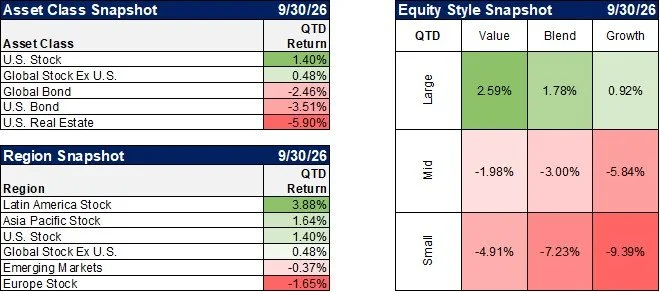
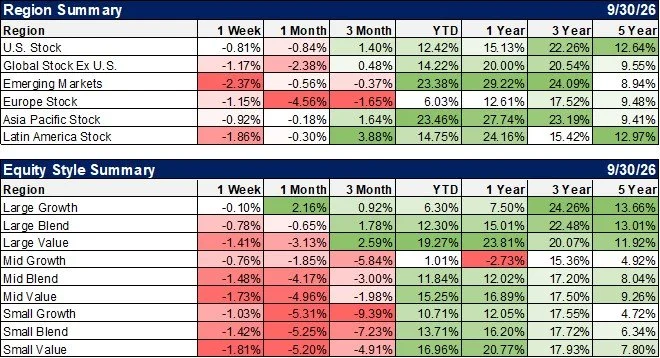
Small cap stock reversal: After posting strong returns in the first half of 2026, small cap stocks [Russell 2000 TR Index] reversed trend and finished the quarter in the red. Still, year to date, small cap stocks remain positive overall.
Value stocks outperform once again: Value stocks across market caps have performed well year to date. In Q3 2026, Large Cap Value [Russell 1000 Value TR] finished up 2.59% while Large Cap Growth [Russell 1000 Growth TR] finished relatively flat at 0.92%.

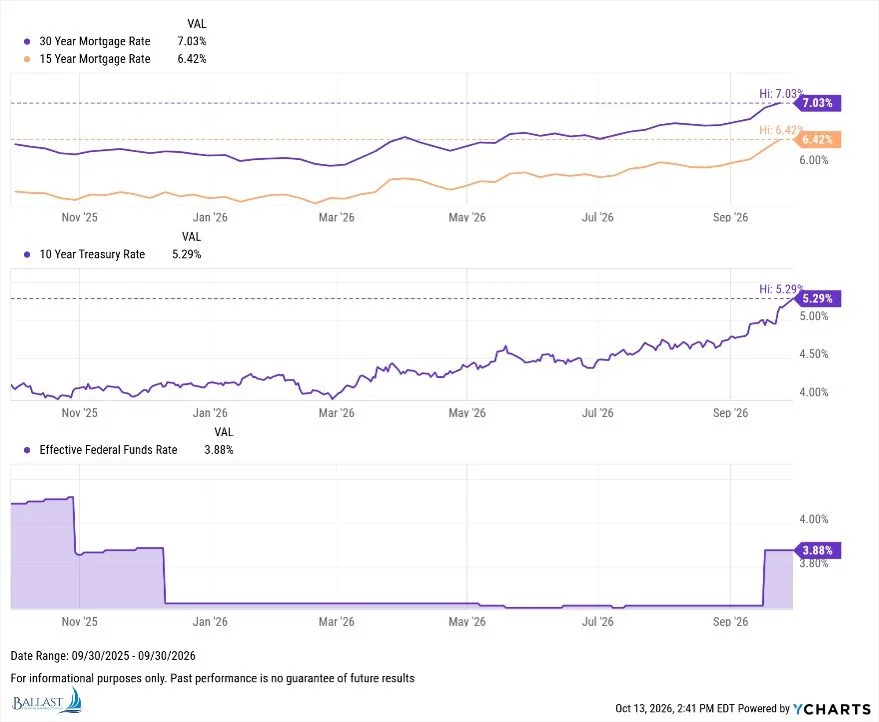
The bond market: The bond market [Bloomberg US Aggregate Index] was among the hardest hit as rate expectations rose. Treasury yields moved sharply higher across the yield curve, with the 10-year Treasury reaching levels not seen in roughly two decades. As yields increased, broad fixed income indexes experienced meaningful declines. While challenging in the near term, higher yields have improved income opportunities for long-term investors.
Economic Summary
The Fed Signals "Higher for Longer"[2]:
At its September meeting, the Federal Reserve increased the federal funds rate by 25 basis points to a range of 3.75%-4.00%, its first rate hike since 2023.
Policymakers cited elevated inflation, resilient economic growth, and strong labor market conditions as reasons for further tightening policy.
Policymakers are prepared to keep rates elevated until inflation moves convincingly toward the 2% target.
Labor Market:
Nonfarm payrolls changed little in September (+29,000), but were down from the average monthly gain of +45,000 over the prior 12 months
The unemployment rate has stayed in a narrow range of 4.1 to 4.3% since March
Generally, the Fed sees labor conditions running at levels consistent with full employment
Inflation:
Inflation remains above the Federal Reserve’s long-term target of 2%.
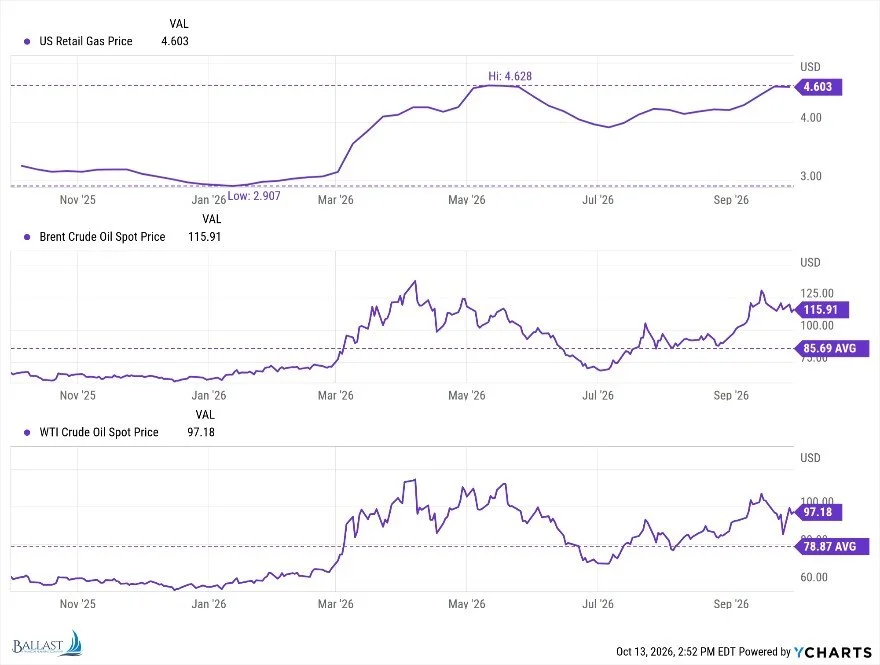
Rising energy prices continue to contribute to inflationary pressures.
Geopolitical disruptions and infrastructure spending demand have also slowed progress toward lower inflation.
Outlook:
Economic growth remains strong.
Fed stays restrictive. Inflation progress has slowed and remains a key risk.
AI continues to drive markets and leadership remains narrow – Diversification is particularly important.
Higher bond yields may improve future portfolio income opportunities.
Maintain a long-term perspective and avoid reacting to short-term volatility.
Index Definitions:
Russell 3000 TR: The Russell 3000 Index is a capitalization-weighted stock market index, maintained by FTSE Russell, that seeks to be a benchmark of the entire U.S stock market. It measures the performance of the 3,000 largest publicly held companies incorporated in America as measured by total market capitalization, and represents approximately 98% of the American public equity market. The index, which was launched on January 1, 1984, is maintained by FTSE Russell, a subsidiary of the London Stock Exchange Group.
Russell 2000 TR: The Russell 2000 tracks the roughly 2000 securities that are considered to be US small cap companies. The Russell 2000 serves as an important benchmark when investors want to track their small cap performances versus other sized companies. The Russell 2000 tends to have a larger standard deviation in comparison to the S&P 500. However, it also tends to yield larger returns in positive market environments.
Russell 1000 Growth TR: The Russell 1000 Growth index is an index that tracks large cap, growth stocks. This benchmark is important for investors that might tilt their investments towards large cap growth. Growth stocks, in comparison to value stocks, are considered companies with a more growth potential, and a higher risk profile. The Russell 1000 growth historically has larger drawdowns compared to the S&P 500, but higher performance as well.
Russell 1000 Value TR: The Russell 1000 Value index is an index that tracks large cap, value stocks. This benchmark is important for investors that might tilt their investments towards large cap value. Value stocks, in comparison to growth stocks, are considered companies with a stable cash flow, and more mature business model. The Russell 1000 value historically has smaller drawdowns compared to the S&P 500, but lower performance as well.
Bloomberg US Aggregate: The Bloomberg US Aggregate Bond Index is a benchmark index composed of US securities in Treasury, Government-Related, Corporate, and Securitized sectors. It includes securities that are of investment-grade quality or better, have at least one year to maturity, and have an outstanding par value of at least $250 Million.
Sources:
[1] Source yCharts.com
[2] Minutes of the Federal Open Market Committee (FOMC) September 15-16, 2026
Disclosure: The opinions expressed herein are those of Ballast Advisors, LLC and are subject to change without notice. The third-party material presented is derived from sources Ballast Advisors consider to be reliable, but the accuracy and completeness cannot be guaranteed. Past performance is not indicative of future results. Nothing contained herein is an offer to purchase or sell any product. This material is for informational purposes only and should not be considered investment advice. Ballast Advisors reserve the right to modify its current investment strategies and techniques based on changing market dynamics or client needs. Broadridge Investor Communication Solutions, Inc. does not provide investment, tax, legal, or retirement advice or recommendations. The information presented here is not specific to any individual's personal circumstances. To the extent that this material concerns tax matters, it is not intended or written to be used, and cannot be used, by a taxpayer for the purpose of avoiding penalties that may be imposed by law. Each taxpayer should seek independent advice from a tax professional based on his or her individual circumstances. These materials are provided for general information and educational purposes based upon publicly available information from sources believed to be reliable — we cannot assure the accuracy or completeness of these materials. The information in these materials may change at any time and without notice. Ballast Advisors, LLC is a registered investment advisor under the Investment Advisers Act of 1940, as amended. Registration does not imply a certain level of skill or training. More information about the firm, including its services, strategies, and fees can be found in our ADV Part 2, which is available without charge upon request.
